
Chef Miggy Cabel Moreno Fights for Tausug Cuisine with Patience, Memory, and Fire | By Kenneth M. del Rosario
- 34 minutes ago
- 5 min read

On a quiet street in Diliman, there is a kitchen where time slows down on purpose. Coconut meat is burned until it turns black and fragrant, spices are ground by hand, and stocks are left to simmer until their natural oils rise and settle into the dish. It is a deliberate, time-intensive process with no shortcuts and no substitutes, one that asks patience from both the cook and the diner. The food that comes out is unfamiliar to many Filipinos, yet deeply Filipino all the same. This is Palm Grill, and this is how Chef Miggy Cabel Moreno has chosen to tell his story.

Moreno, the chef-owner of Palm Grill and Cabel Filipino Heritage, was born in Jolo, Sulu, raised in Zamboanga City, and trained not in a culinary school at first, but in the kitchens of his grandmother and mother. He is Tausug, and he says that plainly, without qualifiers. His food does the same. In 2025, Palm Grill and Cabel each earned a Bib Gourmand from the Michelin Guide, making Moreno the first chef from Mindanao to receive a Michelin distinction, and the only Tausug chef to earn two in a single year.
The awards came after nearly nine years of doing things quietly.
“I didn’t open Palm Grill to chase awards,” Moreno said. “I opened it to introduce dishes from where I come from, and to change the way people think about Mindanao.”
Cooking as inheritance, not reinvention
A registered nurse who once worked in Abu Dhabi, he made a surprising decision upon his return to the country in 2016. Moreno enrolled in culinary school so he could open his own restaurant. It would focus on Southern Mindanao cooking, particularly dishes from the Zamboanga, Basilan, Sulu, and Tawi-Tawi corridor. It would avoid shortcuts, resist dilution, and respect the culture it represents, down to the decision to exclude pork entirely from the menu.
That sense of responsibility did not come out of nowhere. Moreno’s grandmother was an educator, historian, and former politician in Sulu who helped establish the Sulu Museum and Library. His grandfather, an Ilocano doctor assigned to Sulu, founded the Sulu Public Hospital. “They dedicated their lives to preserving culture and serving the community,” he said. “I’m continuing that legacy through food.”
Slow food, Southern Mindanao, and a menu that asks diners to listen
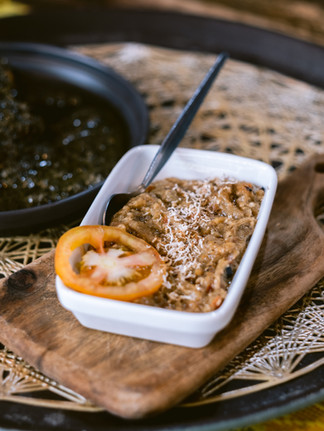
At Palm Grill, that legacy takes very specific forms on the menu. Among the must-try dishes are pianggang manok, the Tausug blackened chicken cooked with burnt coconut and spices; tiula itum, a deeply savory black beef soup; and a rotating selection of sambal and korma dishes that highlight Southern Mindanao’s spice-forward but balanced flavor profile. These are not crowd-pleasers designed for instant familiarity. These are dishes meant to be learned, understood, and remembered.


One of the most distinctive techniques behind these dishes is the use of burnt coconut, a practice unique to Tausug cooking and rooted in pre-colonial tradition. Burning coconut meat alone can take one to two hours, while preparing the house spice blends, known locally as pamapa, can stretch across two full days, a pace that defines the kitchen’s rhythm. It is slow food by nature, long before the term existed.
That philosophy aligns naturally with farm-to-table practices. Palm Grill sources from local farmers and relies on time rather than additives to draw out flavor. Bouillon cubes and artificial enhancers have no place here. The result is food that is bold but grounded, assertive without being overwhelming.
Spice levels can be adjusted, but Moreno is unapologetic about the default. “We educate the palate,” he said. “That starts young. What you feed your children shapes how they eat.”
Moreno’s second restaurant, Cabel Filipino Heritage, sits beside Malacañang Palace and serves dishes from Luzon, Visayas, and Mindanao. The name Cabel comes from his mother’s maiden name, a deliberate choice that honors her family line and the love story between his grandparents, an Ilocano man and a Tausug woman. The restaurant brings those two worlds together on one menu, reflecting Moreno’s belief that Filipino cuisine is not singular, but regional, layered, and collaborative.




“Filipino cuisine is the regional cuisines,” he said. “It’s not just adobo or sinigang. It’s kansi in Bacolod, pakbet in Ilocos, pianggang in Sulu. All of that is Filipino food.”
What recognition changes, and what it should not
When the Michelin Guide arrived in the Philippines, Moreno made a conscious decision not to let it alter the way Palm Grill operated. There was no reworking of recipes, no pressure placed on the kitchen, and no attempt to cook differently for inspectors. Instead, the team was asked to stay steady, protect the process, and cook exactly as they had for years. For Moreno, consistency mattered more than anticipation.
The recognition, when it came, felt less like a turning point and more like confirmation. “It validated the work,” he said. “More than that, it amplified our voice.”
That amplification was immediate and measurable. Moreno shared that Palm Grill saw a sharp increase in business after the Michelin announcement, with sales rising by roughly 40% in the months that followed, driven largely by first-time diners. Many of them were Filipinos who had never tried Southern Mindanao cuisine before. Before the award, a significant portion of Palm Grill’s guests were foreigners. After it, locals began filling the tables. “Filipinos are careful,” Moreno said. “We hesitate to try unfamiliar food. For regional cuisines, that validation helped us be heard.”
With increased demand came operational pressure. Staffing had to grow, supply chains had to adjust, and service had to scale, all while protecting what the Bib Gourmand stands for. Prices could not be raised simply because demand was higher, and quality could not be compromised to serve more plates, a balance Moreno describes as both the challenge and responsibility of the recognition.
A legacy built one table at a time
For Moreno, success has little to do with numbers alone. It shows up in quieter, more human moments. One that stays with him happened after the awards, when a woman celebrated her 60th birthday at Palm Grill. Decades earlier, she had worked as a teacher in Jolo, Sulu, and had not returned since. As the dishes arrived, familiar aromas filled the table, and she broke down in tears. The food brought back memories of her life there, of students she once taught, of a place she thought she had left behind. Her family watched as the meal turned into a homecoming. Moments like that, Moreno said, explain why he does what he does.
“That’s what food is for,” he said. “To bring home closer. To create memories.”
Looking ahead, Moreno has plans beyond Palm Grill’s upcoming NAIA Terminal 3 branch. He is developing a fine dining concept focused entirely on Tausug cuisine, a degustation-style experience that explores the culture in depth. It is a professional challenge he has long wanted to take on. “I want to level up,” he said. “Not to impress, but to tell the story properly.”
Moreno often calls himself a modern-day warrior. Historically, Tausugs were known for resisting colonizers. Today, his battles are fought with flavor. He shares knowledge freely, encourages other Mindanao chefs to open their own restaurants, and rejects gatekeeping outright. “If you want something to grow, you share it,” he said.
At Palm Grill, that belief is cooked into every dish, patiently, deliberately, and with purpose.


Comments